Some stories try to comfort us with clear answers. When the Weather Is Fine offers a quieter kind of comfort.
It stays beside people who are tired, hurt, or simply unsure of where to go next.
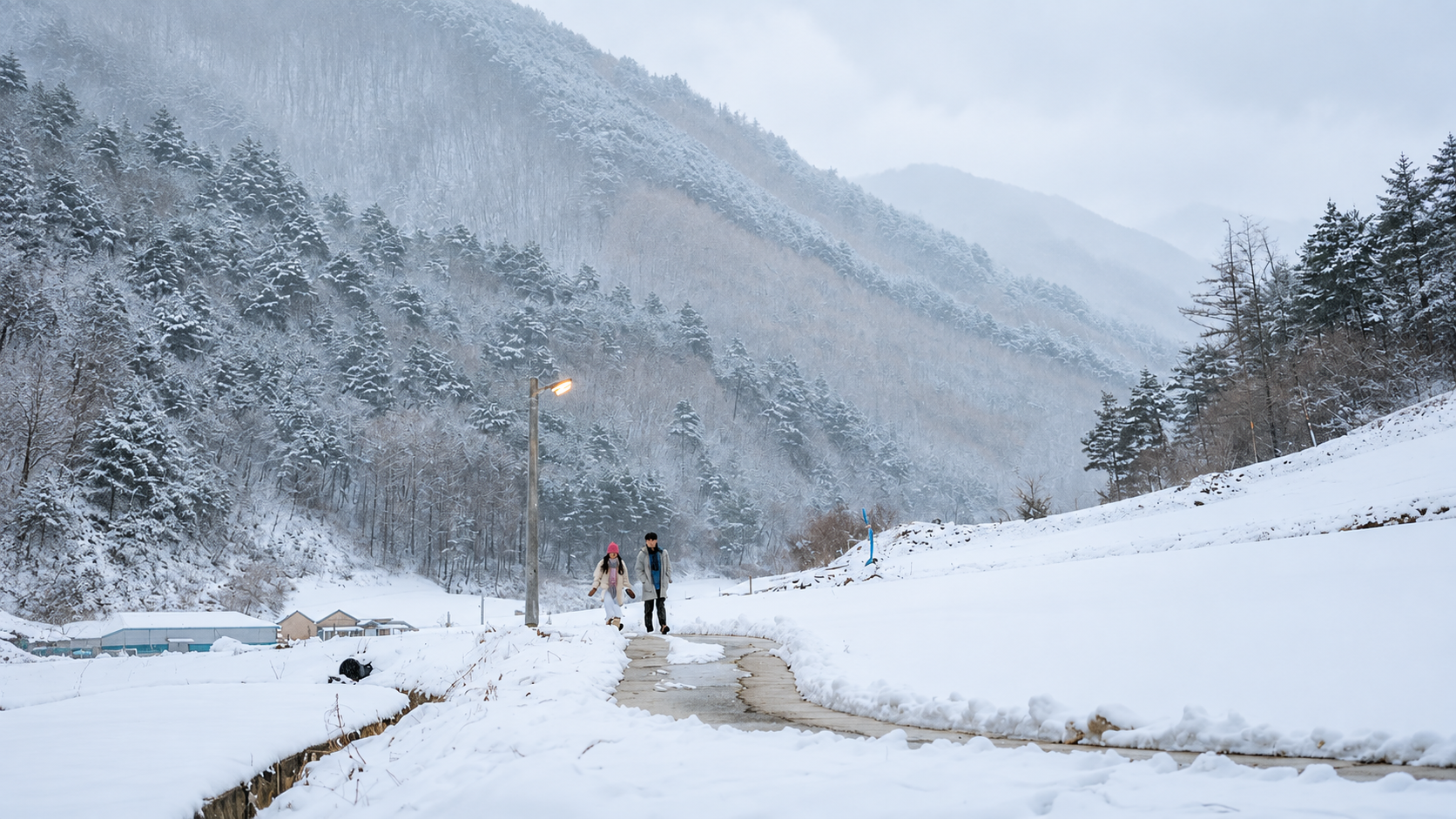
Set in a snow-covered Korean village, the drama follows Mok Hae-won as she leaves Seoul and returns to the countryside where she once lived. There, she reconnects with Im Eun-seop, who runs a small independent bookstore called Goodnight Bookstore.
Nothing changes overnight. Old memories do not disappear, and wounded people do not suddenly become fine.
Instead, the series shows how a warm room, a familiar face, and an unhurried conversation can slowly make life feel more bearable.
This article contains light spoilers about the characters and themes of the series.
When the Weather Is Fine: Drama Information
- Korean title: 날씨가 좋으면 찾아가겠어요
- Network: JTBC
- Original run: February 24–April 21, 2020
- Episodes: 16
- Directors: Han Ji-seung and Jang Ji-yeon
- Screenplay: Han Ga-ram
- Based on: The novel by Lee Do-woo
- Main cast: Park Min-young, Seo Kang-joon, Moon Jeong-hee, and Lee Jae-wook

Hae-won, played by Park Min-young, works as a cello teacher in Seoul. Exhausted by city life and by relationships that have left her emotionally drained, she returns to the rural village where her aunt lives.
Eun-seop, played by Seo Kang-joon, leads a quiet and carefully ordered life while running Goodnight Bookstore.
The drama does not rush toward romance. It first allows its characters to rest, remember, and slowly become honest about the feelings they have avoided.
Watch the Official Trailer
This short official teaser offers a glimpse of the snowy village and the quiet connection beginning to form between Hae-won and Eun-seop.
▶ Watch the official JTBC teaser on YouTube
Returning Home Does Not Always Mean Giving Up
Hae-won does not return to the countryside because she has solved her problems. She returns because she is exhausted.
For international viewers, leaving Seoul for a rural hometown may initially look like a simple escape from city life. In Korea, however, Seoul is often connected to work, education, opportunity, and the pressure to keep moving forward.
Returning home can therefore carry complicated emotions. It may offer rest, but it can also feel like admitting that life in the city has become too difficult.
Hae-won is not searching for a new achievement. She needs somewhere she can stop pretending to be okay.
The countryside in this story is not presented as a perfect escape. The village holds painful memories and complicated relationships of its own. Still, its slower rhythm gives Hae-won enough room to recognize the feelings she had pushed aside.
Watching her return in the middle of winter reminded me that rest does not always begin during a bright or beautiful season.
Sometimes it begins when everything feels cold and still.
The Warm Light of Goodnight Bookstore
Goodnight Bookstore is much more than a background setting.
Eun-seop opens the shop, makes coffee, reads books, keeps a private bookstore journal, and welcomes a small reading group.
The bookstore becomes a place people can enter without having to explain why they came.
Its warmth feels especially meaningful because it is surrounded by snow and darkness. A lamp, a cup of coffee, and shelves filled with books may seem ordinary, but the drama makes these simple details feel deeply reassuring.
Small independent bookstores in Korea sometimes serve as more than retail spaces. They may host reading groups, conversations with writers, and quiet community gatherings.
Goodnight Bookstore plays a similar role in the village. People come together to read, talk, and spend time with one another. Their meetings are modest, but they create a sense of community that is difficult to find in Hae-won’s isolated life in Seoul.
The bookstore made me think about the places we return to when the world feels too loud.
For some people, that place might be a bookstore. For others, it could be a kitchen, a neighborhood café, or simply a quiet room at home.
What matters is not how impressive the place is. What matters is whether we can breathe normally there.
A Love Story That Does Not Rush
The relationship between Hae-won and Eun-seop develops slowly.
Their affection is expressed less through dramatic declarations and more through patience, attention, and the willingness to remain nearby.
Eun-seop does not force Hae-won to speak before she is ready. He gives her time, even when waiting is difficult for him.
That patience makes their relationship feel warm rather than theatrical. Their romance is not about one person rescuing the other. It is about two people gradually becoming honest enough to stand beside each other.

Their walk through the snow captures this feeling particularly well.
They are not rushing toward a destination. They are simply moving through the cold together.
In many romance dramas, silence is treated as an obstacle that must quickly be replaced with a confession. Here, silence sometimes becomes a form of companionship.
Eun-seop’s kindness does not come from finding the perfect words. It comes from allowing Hae-won to approach him in her own time.
The Quiet Meaning of Staying Nearby
People often think comfort means saying something wise or immediately solving another person’s problem.
When the Weather Is Fine presents a quieter form of care.
Someone prepares a warm drink. Someone leaves a light on. Someone waits without demanding an explanation.
These gestures may appear small, but they are meaningful to characters who have spent years hiding what hurts.
The series suggests that waiting can be an expression of affection. A person’s pain may not disappear after one conversation, but feeling safe for long enough can make honesty possible.
This is one reason the drama’s slow pace works so well. It allows emotional change to happen gradually rather than turning healing into a single dramatic moment.
Why Winter Makes the Story Feel Warmer
The winter setting is not only visually beautiful. It shapes the emotional atmosphere of the entire drama.
Snow makes the village quieter. Darkness arrives early, and people naturally gather around warm rooms and lights.
Against this cold background, every small act of kindness becomes more noticeable.
A streetlight on an empty road, a fire inside the bookstore, and two people waiting for each other carry more emotional weight because the surrounding world feels so still.

The winter scenery also reflects the characters.
Their feelings appear frozen at first, held beneath old memories and words that were never spoken. As the story continues, those emotions slowly begin to move again.
The drama does not promise that every wound will disappear when spring arrives. It simply shows that a frozen season does not last forever.
The Village Is Warm, but It Is Not Perfect
The village community gives the drama much of its warmth, but the story does not present rural life as perfect.
People know one another’s histories. Private matters can quickly become community knowledge, and old relationships are difficult to avoid.
This closeness can be comforting, but it can also feel restrictive.
Hae-won returns to a place filled with both affection and painful memories. The same village that allows her to rest also requires her to face parts of her past.
That balance keeps the story from becoming a simple fantasy about leaving the city.
Healing does not happen because the countryside is magically better than Seoul. It happens because Hae-won finally has the time and support to look honestly at what she has been carrying.
Comfort Does Not Always Need an Answer
One of the most comforting things about When the Weather Is Fine is that it does not pretend every wound can be neatly explained or completely healed.
The characters carry regret, loneliness, family conflict, and memories they would rather avoid. Some relationships can be repaired, while others remain complicated.
Even so, life can become warmer through ordinary acts: showing up, listening, sharing a meal, reading together, and finally saying what should have been said long ago.
After watching the drama, I did not feel as though it had given me a solution to life’s problems.
Instead, it left me with a quieter thought:
Maybe we do not always have to become okay immediately. Sometimes it is enough to find a place where we can rest until the weather becomes a little warmer.
Where Can You Watch When the Weather Is Fine?
When the Weather Is Fine has official title pages on Netflix and TVING.
Streaming availability may differ depending on the country and date. Please check the service available in your region before watching.
▶ Check When the Weather Is Fine on Netflix
▶ Check When the Weather Is Fine on TVING
More Korean Films and Dramas to Read
If you enjoy quiet Korean stories about ordinary life, food, memory, and emotional recovery, you may also like these reviews.
▶ Little Forest: Korean Food, Seasons, and the Comfort of Home
▶ My Liberation Notes: Finding Freedom in an Ordinary Life
▶ 20th Century Girl: First Love, Friendship, and Memories of 1999
▶ Read the Korean version of this article
Image and Drama Information Sources
The featured image and body images used in this article are official publicity images released through the JTBC website and photo gallery for When the Weather Is Fine.
This article was written for personal commentary and criticism. The images are used only where necessary to support the discussion of the drama.
답글 남기기